
A question I hear on almost every bathroom renovation: "Should we go curbless? Isn't that what everyone's doing now?"
Curbless showers are beautiful, but a curb isn't the old-fashioned option. They do different jobs and look different, and if you do choose a curb, how it's finished matters just as much.
Curb or no curb
The curb is a small wall at the shower entry that keeps water in. It frames the shower as its own space.
Pros: forgiving if the floor slope isn't perfect, works on a standard subfloor, usually costs less.
Cons: it's a step, it visually divides the room, and the top collects water.
Curbless runs the bathroom floor straight into the shower, sloped to a drain. It feels open and makes the room read larger.
Pros: no step, easier to live with as you age, cleaner lines.
Cons: the floor usually has to be recessed into the framing, so it must be planned early. It leaves less room for error and usually costs more.
Neither one is the better shower. It depends on the house and the people using it.
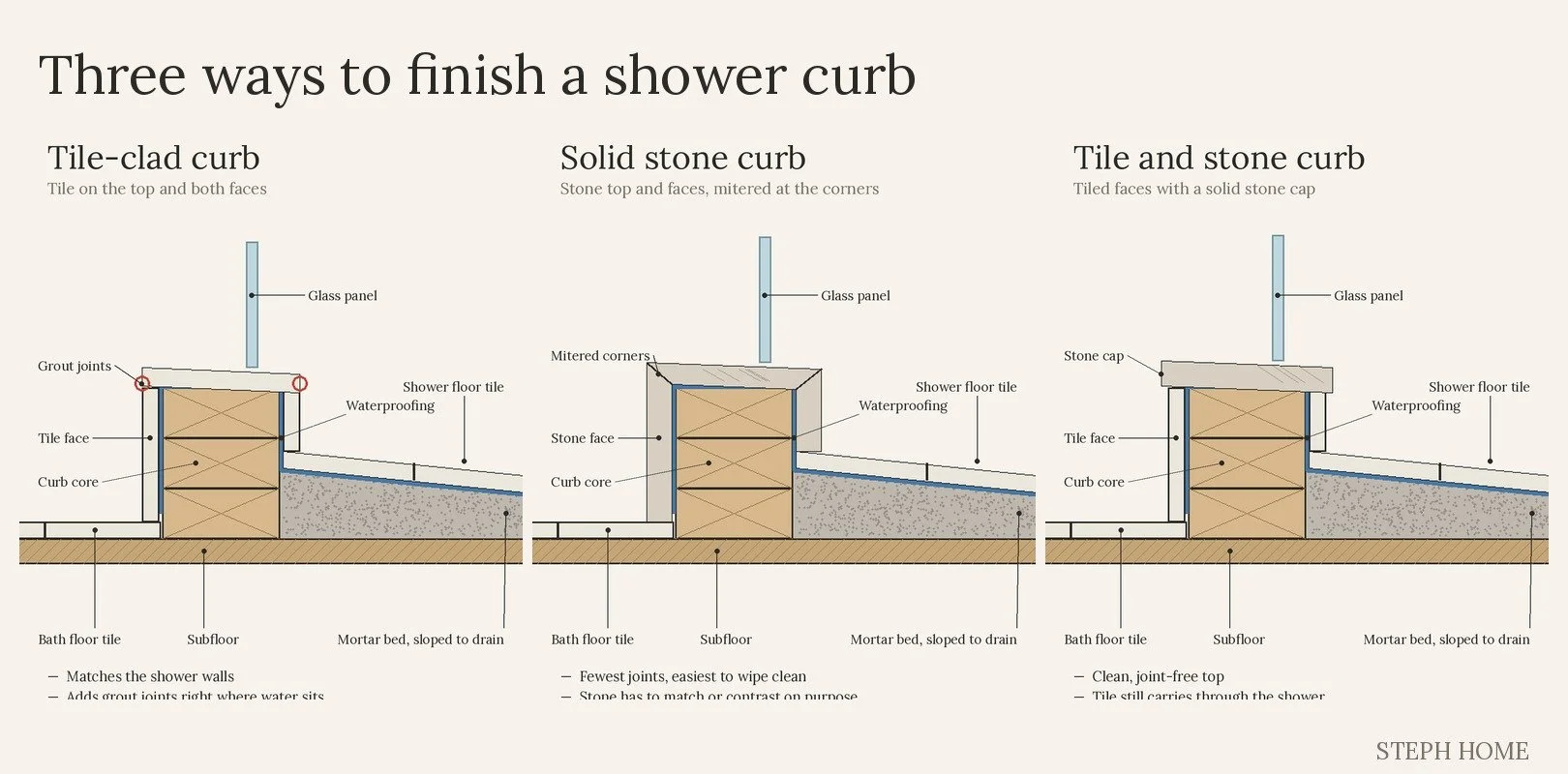
Three ways to finish a curb
Every curb has the same core and waterproofing inside. What changes is the finish, and that decides what you see and what you clean.
1. Tile-clad. The shower tile wraps the top and both sides, so the curb blends into the shower.
Pros: seamless, and usually the least expensive.
Cons: grout joints sit right on top, where water collects and grout wears first.
2. Solid stone. One piece of stone or quartz on top, with matching faces mitered at the corners. It reads like a stone threshold and can tie back to the vanity top.
Pros: fewest joints, easiest to clean, very durable.
Cons: costs more, and the stone has to match or contrast on purpose.
3. Tile faces with a stone cap. Tile on the sides, a solid stone piece on top.
Pros: a clean, joint-free top while the tile still carries through.
Cons: two materials to coordinate in color and thickness.
Decide it early
Curbless has to be decided before framing, and the curb finish before the tile order goes in. Both are easy conversations on paper and expensive ones later.
If you liked this, you might also enjoy inset vs. full overlay cabinetry. And if you're planning a bathroom, I'm always happy to talk it through.
Until next time,
Steph
